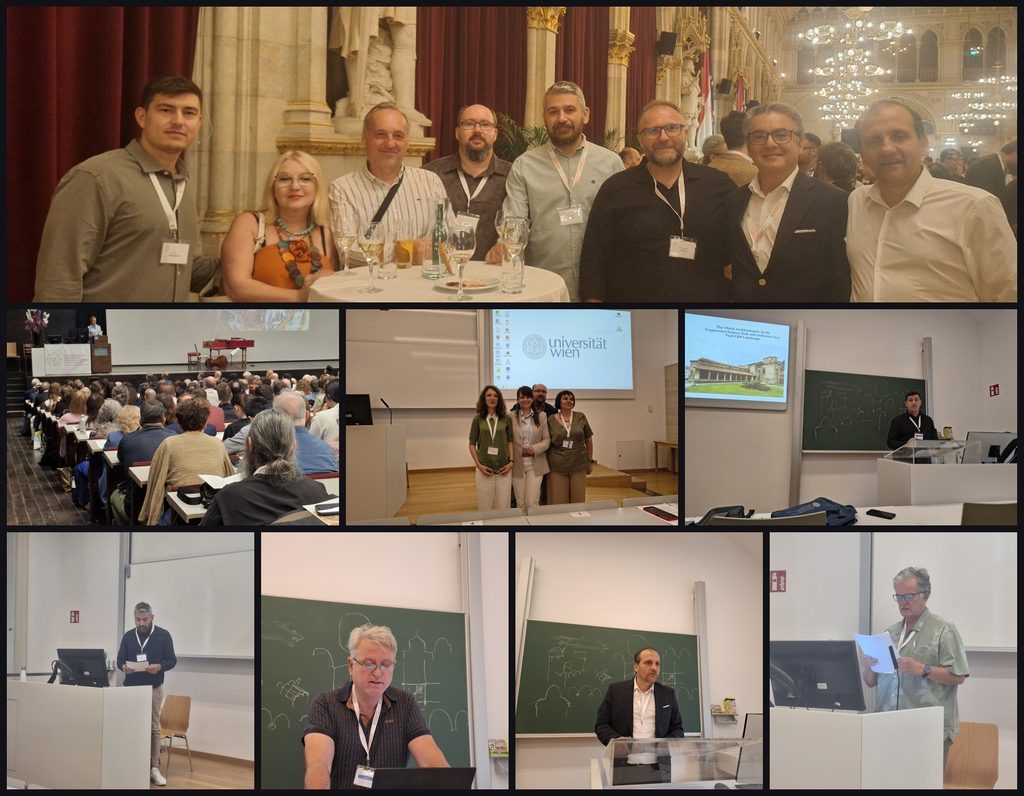
Комитетот за византологија и медиевистика на Република Македонија – Скопје учествуваше на XXV Меѓународен конгрес за византиски студии (ICBS 2026), одржан во Виена од 24 до 29 август 2026 година, со тема „Byzantium beyond Byzantium“.
Комитетот беше застапен со две тематски сесии и една тркалезна маса.
Тематска сесија 2.09 TS: „Cultural Cross-References in Late Byzantine Literature“ Организатор: проф. д-р Даниела Тошева
проф. д-р Даниела Тошева – „Eros Beyond Byzantium: Cultural and Philosophical Cross-References in Hysmine and Hysminias“
Maciej Helbig – „No Goat – No Milk: Echoes of Classical Greek Literature in John Tzetzes’ ἐκ τῶν τραγίσκων οὔκ ἀμέλγεται γάλα“
д-р Марија Чичева-Алексиќ – „Plethon and the Byzantine Voice in Η Γυφτοπούλα (The Gypsy Girl)“
проф. д-р Јасмина Поповска – „Practical Wisdom and Cosmic Order: Plethon’s Reinterpretation of Phronesis in a Cross-Cultural Horizon“
Тематска сесија 2.24 TS: „Culture and Art on the Territory of the Ohrid Archbishopric“ Организатор: д-р Орданче Петров
д-р Орданче Петров – „Mortuary Practices and the Transformation of Sacred Space in Byzantine and Post-Byzantine Macedonia“
д-р Александар Василески – „The Architecture and the Wall Painting of the Katholikon of the Treskavec Monastery in the Second Half of the 13th and First Half of the 14th Century“
д-р Роберт Михајловски – „Art and Culture on the Territory of the Bishopric of Pelagonia“
Тркалезна маса 6.03 RT: „Macedonia Within or Beyond Byzantium“ Организатор: проф. д-р Тони Филипоски
проф. д-р Митко Панов – „Macedonia Between Empires: Religion and Identity (7th–10th Centuries)“
проф. д-р Стојко Стојков – „War in Symbols About the Fate of the Samuel State“
проф. д-р Маја Ангеловска-Панова – „Monastic Rules between Byzantine Tradition and the Local Context: The Case of the Typikon of Veljusa“
д-р Катерина Христовска – „Byzantine Macedonia in the Eleventh and Twelfth Centuries: Monetary Evidence“
м-р Филип Марковски – „The Ohrid Archbishopric in the Fragmented Empire: Role and Influence in a Post-1204 Landscape“
проф. д-р Тони Филипоски – „Disintegration of Stefan Dušan’s State in Romania: A Case Study of Macedonia (1355–1371)“
Презентациите наидоа на позитивен одзив и плодни дискусии.
Овој конгрес за византиски студии во Виена претставува досега најголемото и најзначајното претставување на Комитетот за византологија и медиевистика на Република Македонија на меѓународните конгреси.
Комитетот ќе се заложи за објавување на трудовите од сесиите како ново продолжение на едицијата Macedonia Byzantina.
На 24 август 2022 година, во рамките на XXIV Меѓународен конгрес за византиски студии (Венеција и Падова, 22–27 август 2022), членовите на Комитетот за византологија и медиевистика на Република Македонија – Скопје учествуваа со тематска сесија.
Сесија: TS52 – „Macedonia and the Balkans: The Area of Interaction Between the Slavic World and Byzantium (9th–14th Century)“ Место: San Giobbe Aula 10C, Campus Economico, Università Ca’ Foscari, Венеција Организатор: проф. д-р Тони Филипоски
Презентации:
проф. д-р Тони Филипоски – „The Ethnic Designation of Samuel’s State“
проф. д-р Стојко Стојков – „The Term ‘Slavs’ and Its Gradual Obsolescence in Byzantine Sources (9th–12th Centuries)“
д-р Александар Василески – „The Fresco Painting of the Ohrid Archbishopric in the Second Half of the 14th Century: Case Study Zrze Monastery“
д-р Орданче Петров – „Archaeological Evidence on Military Reoccupation of the Balkans Hinterland Strongholds in the Late 12th–Early 13th Century: Case Study Prosakos Fortress“
Со ова учество Комитетот го потврди своето присуство во меѓународната византолошка заедница и во рамките на Меѓународното здружение за византиски студии (AIEB).
Due to its remarkably long duration, territorial expanse, geographical situation and complex cultural traditions, Byzantium acted as a temporal and spatial bridge connecting different periods, geographical areas, and cultures. Byzantium acted as a transition between ancient, medieval and early modern worlds around the Mediterranean basin, Eurasia and the Near East through reception, appropriation, and innovation. It connected different geographical and cultural spaces through political, economic, material, and cultural networks in many of which it constituted an important node. Centering on the key theme of “Byzantium – Bridge between Worlds,” the 24th International Congress of Byzantine Studies aims to explore this connecting and mediatory role of Byzantium. It also hopes to initiate proposals on bridging interdisciplinary gaps within Byzantine studies and strengthening dialogue with other relevant fields.
Thematic Free Communications
(Selected from the RT proposals sent by National Committees)
Australasia
1. Embodied Mystagogy: Liturgy, Materiality and the Senses
Convenor: Ken Parry
2. The Byzantine Balkans: A Bridge to the West and North
Convenor: Amelia Brown
Austria
3. Byzantine poetry between fictionality and factuality
Convenors: Krystina Kubina and Nikos Zagklas
Former Yugoslav Republic of Macedonia
4. Church Slavonic Literacy as Communication between East and West
Convenor: Emilija Crvenkovska
5. Macedonia and the Balkans – The Area of Interaction Between the Slavic World and
Byzantium (IX-XIV Century)
Convenor: Vitomir Mitevski
France
6. Les icônes dans les collections muséales d’Europe occidentale
Convenor: Raphaëlle Ziadé
7. Mediterranean Migrations in the 7th-9th Centuries: Near East/Africa/Italy
Convenors: Filippo Ronconi and Marek Jankowiak
8. La prosopographie au coeur des relations entre Byzance et ses voisins
Convenors: Vivien Prigent and Vincent Puech
9. Mobilités, fonctionnaires de l’état et hommes d’église dans l’Empire byzantin
Convenors: Sophie Métivier and Luisa Andriollo
10. Le developpement des savoirs scientifiques et techniques à Byzance
Convenors: Stavros Lazaris and Ines Pérez Martin
11. La Notitia Dignitatum: émission, diffusion, réception